

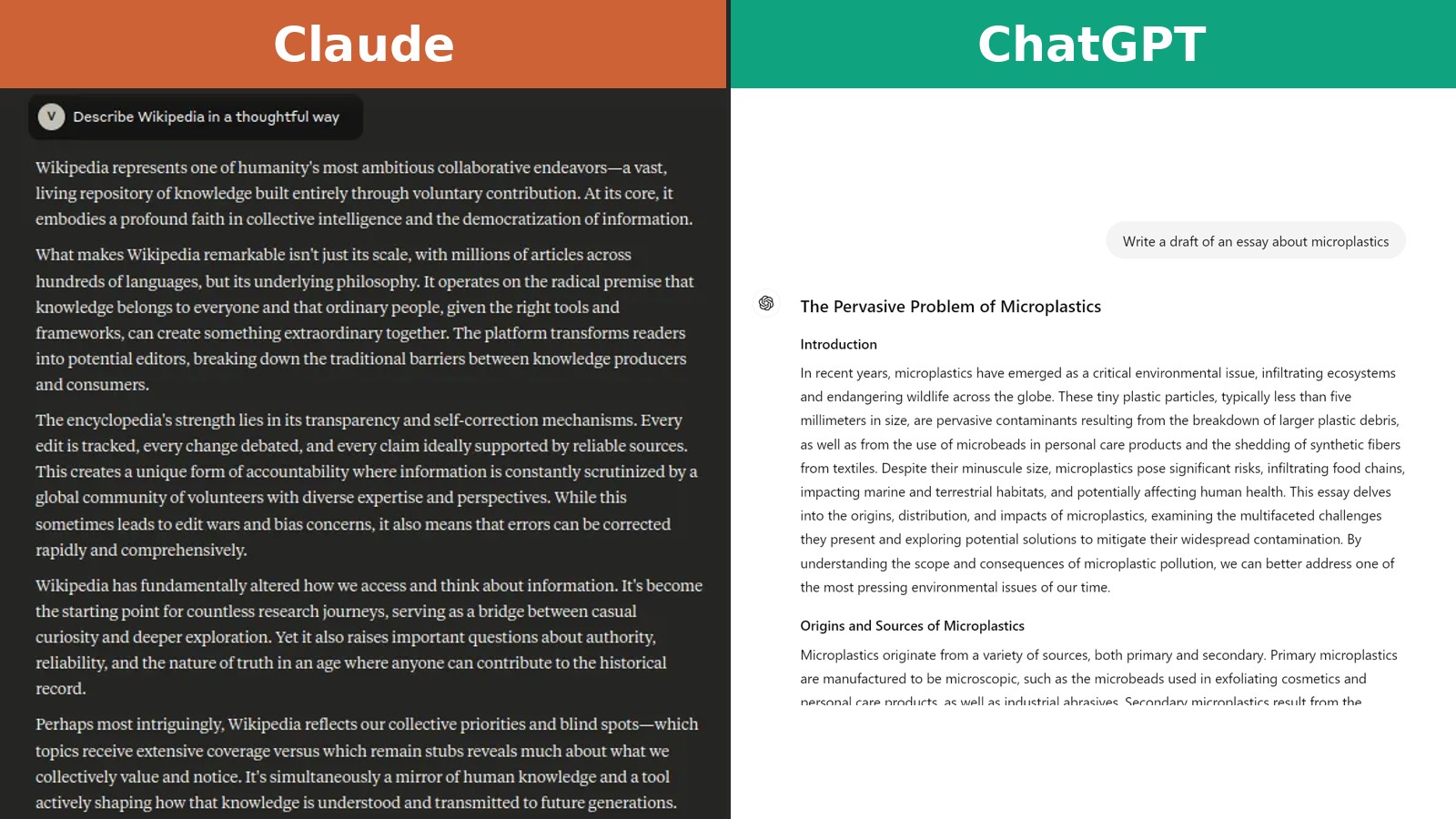
Claude and ChatGPT are both top-tier AI assistants, and at the price most people pay they cost exactly the same: Claude Pro and ChatGPT Plus are each $20 a month. Neither is simply “smarter” in a way that settles the choice. The real differences sit underneath — how much text each can hold in view at once, what else the subscription includes besides chat, and how the higher tiers are priced. Pick by use case: Claude is built around long documents, large codebases and long-form writing, with a context window of up to 1 million tokens on its current models; ChatGPT is the broader platform, adding image creation, voice, deep research, scheduled tasks and custom GPTs around the chat. Every figure here comes from Anthropic’s and OpenAI’s own pages, checked in November 2026.
The two ladders: plans and prices
The headline prices match, but the ladders around them do not: Claude has no cheap paid rung and tops out at $200; ChatGPT has an $8 entry tier and tops out at $500.
| Claude (Anthropic) | ChatGPT (OpenAI) | |
|---|---|---|
| Free | $0 — limited usage, chat on web, desktop and mobile, web search, Artifacts, memory, connectors | $0 — unlimited text chats, with limited uploads, image creation, voice, deep research and Codex access |
| Entry paid tier | — (no equivalent) | Go: $8/month — more messages with tools, uploads, image creation and voice than Free, longer memory; may include ads |
| Main paid tier | Pro: $20/month, or $17/month billed annually ($200 up front) | Plus: $20/month, billed monthly |
| What the main tier adds | More usage than Free, Claude Code, Projects, more Claude models, Claude in Chrome and Microsoft 365, handing off and scheduling tasks | Advanced reasoning models, expanded messages and uploads, expanded deep research, Projects, scheduled tasks and custom GPTs, expanded Codex usage |
| Heavy tier | Max: $100/month — 5x Pro usage, plus $100/month API credits | Pro 100: $100/month |
| Top tier | Ultra: $200/month — 10x Pro weekly usage, no five-hour limit for verified accounts, $200/month API credits | Pro 200: $200/month and Pro 500: $500/month — Pro 500 is the only tier with Ultrafast |
Sources: Anthropic’s Claude pricing page and OpenAI’s ChatGPT pricing page, with Pro tiers confirmed in OpenAI’s help center. Prices exclude tax.
Three billing details matter more than the headlines. First, Claude Pro is the only main tier with an annual discount — $17 a month against $20 — while ChatGPT’s individual plans are monthly only. Second, neither company publishes a fixed message count: Claude’s limits reset on a rolling five-hour window, with weekly limits on paid plans, and how fast you reach them depends on the model, chat length and file sizes. Third, a chat subscription is not API access on either side — developer usage is billed separately per token, apart from the monthly API credits bundled with Claude Max and Ultra and with ChatGPT Pro.
The current models
Model names are where comparison articles go stale first. As listed on the official pages in November 2026:
Claude’s current lineup (Anthropic’s models overview) has four tiers. Claude Fable 5.2 is the top model, for demanding reasoning and long-horizon agentic work. Claude Opus 5.5 is for long-running agentic coding and knowledge work, and is the model Anthropic recommends starting with for most workloads. Claude Sonnet 5.5 is pitched as the best combination of speed and intelligence, and Claude Haiku 5.5 is the fastest, cheapest tier, for high-volume tasks. All four support text and image input, vision and tool use.
ChatGPT’s current family is GPT-6. OpenAI’s pricing page describes Free as unlimited text chats with GPT-6 (tools limited), Plus as adding advanced reasoning models with GPT-6, and Pro as adding Pro reasoning powered by GPT-6 Astra. Its help center’s guide to GPT-6 and other models in ChatGPT explains that GPT-6 Sol sits behind the GPT-6 option in the picker, while the Pro thinking option runs on GPT-6 Pro, powered by GPT-6 Astra. Separate GPT-6.1 models (Sol, Terra and Luna) appear in ChatGPT Work and Codex rather than ordinary chats. The shape is the same on both sides — a fast cheap tier, a balanced everyday tier and a top reasoning tier — and your plan decides which you can select.
Context windows: how much each can hold in view
The context window is the text the model can reference at once — your messages, attached documents, its previous replies and its new answer all share the space. It is the biggest measurable difference between the two products right now.
Claude. Anthropic’s pricing page lists a context window of “up to 1M, varies by model” on every plan, and its help center’s per-model table for paid plans spells that out: the current models — Fable 5.2 and 5.1, Opus 5.5 and Opus 5, Sonnet 5.5 and Sonnet 5, and Haiku 5.5 — each have a 1M-token window in paid chat; several older models sit at 500K; anything outside that list is 200K, about 500 pages of text. On the API, Anthropic’s context window documentation gives the same current models 1M tokens with up to 128K output tokens per request, and older models 200K.
ChatGPT. OpenAI describes the ladder in words rather than one headline number: Free has “limited memory and context,” Plus “expanded memory and context,” and Pro “maximum memory and context.” Its pricing page also warns that ChatGPT manages a shared context window, and the portion available for your input is smaller than the total, because space is also used by system instructions, memories and internal processing. In ChatGPT Work and Codex, OpenAI’s help center lists a default window of 500,000 tokens for GPT-6.1 Sol. So Claude publishes the larger chat window as a plain per-model number, while ChatGPT’s usable space depends on plan and mode and is partly consumed before you type anything.
A bigger window is not automatically a better answer. Anthropic’s own documentation warns that as token count grows, accuracy and recall degrade — context rot — so curating a long conversation matters on both products. And a large window does not make answers true: both models can state false things fluently, the subject of our guide to what an AI hallucination is.
The ecosystem around the chat
This is where the two products have genuinely diverged.
ChatGPT is the wider platform. Even Free includes limited image creation, voice chats and deep research. Plus adds expanded deep research, scheduled tasks and custom GPTs — shareable, pre-configured versions of ChatGPT built for a specific job — alongside Projects and expanded Codex usage. Pro adds unlimited and faster image creation, maximum deep research and Dot, an always-on agent. If your work regularly needs an image, a voice conversation or a researched report, that breadth is ChatGPT’s clearest advantage; Claude has no equivalent for image creation.
Claude is the deeper workbench. Free already includes web search, file creation with code execution, memory across conversations, connectors and Artifacts — Claude’s side-panel format for documents and code you keep working on. Paid plans add Projects, Claude in Chrome and Microsoft 365, and Claude Code, drawing on the same usage pool as your chats. Where ChatGPT spreads across media types, Claude concentrates on text, documents and code in one long context.
One overlap: file handling. ChatGPT’s upload allowances are plan-dependent in ways that catch people out — our breakdown of ChatGPT file upload limits works through them. Claude’s long window takes in very large documents in one conversation, but its usage limits still apply to the work done on them.
Writing and coding: where each tends to be chosen
This article makes no “we tested” claim and prints no benchmark scores — neither company publishes a head-to-head test of the other’s product. What can be said from the companies’ own positioning is where each tends to be chosen:
- Long-form writing and editing. Anthropic positions its top tiers for knowledge work; with the 1M-token window, Claude is the usual pick for drafting or editing a long document that must stay consistent with a large brief or manuscript held in the same conversation.
- Coding. Both bundle a dedicated coding agent — Claude Code in every paid Claude plan, Codex with expanded usage from ChatGPT Plus up. Anthropic positions Opus 5.5 for long-running agentic coding, and the larger window suits a big codebase. ChatGPT counters with the surrounding platform: Codex plus Work, projects and custom GPTs in one subscription.
- Research. ChatGPT’s deep research is a named, tiered feature — limited on Free, expanded on Plus, maximum on Pro — making it the straightforward choice for web research. Claude offers web search on every plan, including Free, but sells no equivalent tiered research product.
- Everyday mixed use. For a bit of everything — a quick question, an image, a voice chat, a summary — ChatGPT’s Free and Go tiers cover more ground for $0–$8 than Claude’s Free tier.
Treat these as starting points, not verdicts: with models this close, your prompt and material usually matter more than the logo.
If you build with the API
Developer costs are separate, billed per million tokens (MTok) on both platforms. Headline rates, from Anthropic’s models overview and OpenAI’s API pricing page:
| Tier | Claude API (input / output per MTok) | OpenAI API (input / output per MTok) |
|---|---|---|
| Top | Fable 5.2 — $8 / $40 | GPT-6 Astra — $10 / $50 |
| Everyday flagship | Opus 5.5 — $4 / $20 | GPT-6.1 Sol — $2 / $10 |
| Mid | Sonnet 5.5 — $2 / $10 | GPT-6.1 Terra — $1 / $5 |
| Fast / cheap | Haiku 5.5 — from $0.10 / $0.50 | GPT-6 Luna — $0.10 / $0.50 |
The shape matches on both sides: a few dollars per million tokens at the balanced tier, two to five times more at the top, and a fast tier that is nearly free by comparison. Cached-input discounts and speed modes move the real bill, so price a specific workload on the page itself rather than from any summary — including this one.
Which should you pick?
- Pick Claude if your main work is long documents, long-form writing, or coding across a large codebase; if you regularly attach material that would overflow a smaller window; or if you want the annual discount on the $20 tier ($17 billed yearly).
- Pick ChatGPT if you want one subscription that also generates images, talks by voice, runs deep research and lets you build or use custom GPTs; if you want the cheapest paid step (Go at $8); or if your work is many small tasks rather than a few long ones.
- Stay on the free tiers first if your use is occasional. Both are genuinely usable — Claude’s includes web search and Artifacts, ChatGPT’s unlimited text chats with limited tools — and the right moment to pay is when a specific limit stops you.
- Consider both only if your work splits cleanly in two — long-document and coding work in one, media and research in the other. For most people, one $20 tier is enough.
Should you switch from ChatGPT to Claude (or back)? Switching costs are low — both let you cancel and keep access until the end of the billing period — but the reasons are usually one of three: a context or document-size wall, a feature only one has (image creation and custom GPTs on one side, Claude Code and the 1M window on the other), or usage that outgrows the $20 tier, where the heavy ladders diverge ($100–$200 against $100–$500). If none of those is happening, the assistant you already know is probably the right one.
Frequently asked questions
Is Claude better than ChatGPT for coding? Anthropic positions its Opus tier for long-running agentic coding, includes Claude Code in every paid plan, and its 1M-token window helps with large codebases. OpenAI includes Codex from its paid plans up, inside a broader platform. This page prints no benchmark winner, because neither company publishes a neutral head-to-head test.
Which is cheaper, Claude or ChatGPT? At the main tier they are identical: $20 a month. Below that, ChatGPT has an $8 Go plan and Claude has nothing; Claude Pro alone offers an annual rate ($17 a month, $200 up front). Above that, Claude’s heavy tiers are $100 and $200, while ChatGPT Pro runs $100, $200 and $500.
What is the difference between Claude and ChatGPT’s context windows? Claude’s current models have a 1M-token window in paid chat, per Anthropic’s help center, with older models at 500K or 200K. OpenAI describes ChatGPT’s context only in relative terms — limited on Free, expanded on Plus, maximum on Pro — and notes that part of the window is used by the system before your input. In ChatGPT Work and Codex, GPT-6.1 Sol’s default window is 500,000 tokens.
Can Claude generate images like ChatGPT? Anthropic’s pricing page does not list image creation among Claude’s features; it is a ChatGPT feature, limited on Free and unlimited and faster on Pro. Claude’s listed strengths run the other way: Artifacts, Projects and Claude Code.
Do either of them remember past conversations? Yes. Memory across conversations is listed on Claude’s Free plan; ChatGPT lists limited memory on Free, longer memory on Go, and expanded memory and context on Plus and Pro.
Which is better for students on a tight budget? Start free — both free tiers are genuinely usable. If you do pay, ChatGPT’s $8 Go plan is the cheapest paid step either company offers; Claude has no equivalent rung, and its first paid step is the full $20 Pro (or $17 billed annually).
This comparison is a November 2026 snapshot, checked against Anthropic’s and OpenAI’s own pricing, model and help pages on that date. Both companies release new models every few months — if a figure here disagrees with claude.com or chatgpt.com, the official page is right.