

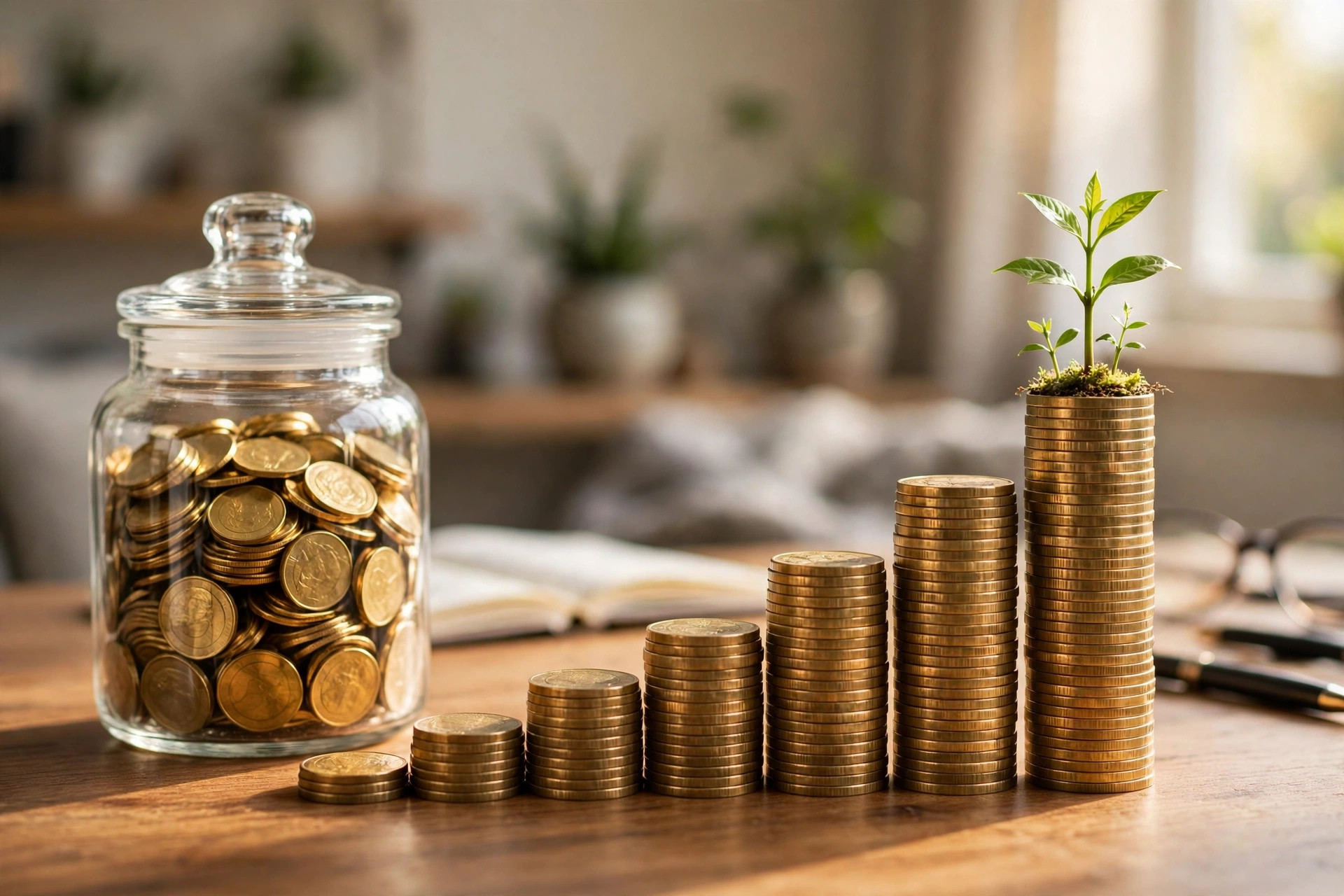
Compound interest is interest calculated on your original money and on the interest that money has already earned, so the amount grows faster every period instead of by the same flat slice. Put $1,000 at 5%, compounded once a year, and year one adds $50, taking you to $1,050 — but year two adds 5% of $1,050, which is $52.50, taking you to $1,102.50. That extra $2.50 is the whole idea: it looks trivial in year two, and it is the reason the balance reaches about $1,629 after ten years instead of the $1,500 that simple interest, which pays only on the original $1,000, would give you. The Consumer Financial Protection Bureau uses exactly this example: you earn interest on the money you saved and on the interest you earn along the way.
Nothing about the rate changed between those two years. The base changed. Every idea in this article is that one sentence wearing different clothes.
How compound interest works, year by year
Follow the CFPB’s $1,000 at 5%, compounded annually, a little further:
| Year | Balance at start | Interest at 5% | Balance at end |
|---|---|---|---|
| 1 | $1,000.00 | $50.00 | $1,050.00 |
| 2 | $1,050.00 | $52.50 | $1,102.50 |
| 3 | $1,102.50 | $55.13 | $1,157.63 |
| 5 | — | — | $1,276.28 |
| 10 | — | — | $1,628.89 |
| 20 | — | — | $2,653.30 |
| 30 | — | — | $4,321.94 |
Read the last three rows slowly. The first decade adds about $629. The second adds about $1,024. The third adds about $1,669 — more than the original deposit, from a rate that never rose above 5%. Growth that accelerates is called exponential, and it is why time in a compounding account matters more than cleverness about the rate. The SEC’s investor site makes the same point for investments: compound growth is earning a return on your money and on the return that money earns, like a snowball picking up more snow with every turn because there is more snowball to pick it up with.
Two honest limits belong here. First, these are illustrations at a fixed rate — a savings account’s rate moves, and an investment’s return bounces around and can be negative, so a real balance will not trace this smooth curve. Second, inflation and tax eat part of any real gain. Compounding is the engine, not the whole car.
Simple interest vs compound interest
Simple interest is calculated on the principal alone, every time. The formula is I = P × r × t — principal times rate times time — and because the base never grows, neither does the payment.
| Simple interest | Compound interest | |
|---|---|---|
| Interest is paid on | The original principal only | Principal plus all interest already earned |
| Interest each year at 5% on $1,000 | $50, every year | $50, then $52.50, then $55.13, and rising |
| $1,000 at 5% after 10 years | $1,500 | $1,628.89 |
| $1,000 at 5% after 30 years | $2,500 | $4,321.94 |
| Where you meet it | Some bonds and short-term loans; a teaching baseline | Savings accounts, CDs, reinvested investments — and carried card balances |
Over one year with annual compounding, the two are identical: $50 either way. The gap is a creature of time. After 30 years in the table above, compounding has added $1,821.94 more than simple interest on the same $1,000 at the same 5% — without you depositing another cent. That is also why “simple vs compound” is folded into this article rather than given its own: in every serious explainer, and in every real account, the comparison is the definition.
The compound interest formula, and what each letter means
A = P(1 + r/n)^(nt)
- A — the final amount: principal plus all the interest.
- P — the principal: what you start with.
- r — the annual interest rate, written as a decimal. 5% becomes 0.05. Forgetting this conversion is the most common reason a hand calculation explodes.
- n — how many times interest compounds in a year: 1 for yearly, 4 for quarterly, 12 for monthly, 365 for daily.
- t — the time, in years.
Work it once, slowly. $1,000 at 5% for 10 years, compounded monthly: P = 1,000, r = 0.05, n = 12, t = 10. The bracket becomes (1 + 0.05/12) = 1.004167; the exponent is 12 × 10 = 120; so A = 1,000 × 1.004167^120 ≈ $1,647.01. Compounded just once a year, the same inputs gave $1,628.89 above. Same money, same rate, same decade — monthly compounding adds about $18 more, a difference the next section puts in its proper, modest place.
If you only want the interest itself, subtract the principal: interest = A − P. And if interest compounds once a year, n is 1 and the formula shrinks to the friendlier A = P(1 + r)^t, which is all the year-by-year table above used.
A special case deserves a warning label. Continuous compounding — interest added at every instant, calculated as A = Pe^(rt) — appears in textbooks, where $1,000 at 5% for 10 years becomes $1,648.72, barely above the monthly figure of $1,647.01. It is a mathematical limit, useful in finance theory; almost no ordinary savings account pays that way.
How often interest compounds: annual, monthly, daily
More frequent compounding always pays a little more, because interest starts earning its own interest sooner. How little is worth seeing in numbers — $10,000 at a 4% rate for one year:
| Compounding | Final amount after 1 year | Effective yearly yield (APY) |
|---|---|---|
| Annually (n = 1) | $10,400.00 | 4.00% |
| Quarterly (n = 4) | $10,406.04 | 4.06% |
| Monthly (n = 12) | $10,407.42 | 4.07% |
| Daily (n = 365) | $10,408.08 | 4.08% |
Daily beats annual by $8.08 on $10,000 over a full year. Real money, but small — and it stays small relative to the things that actually move a balance: the rate itself, the amount you deposit, and the years you leave it alone. The CFPB lists the levers in the right order of usefulness: increasing the compounding frequency helps, but so do finding a higher rate and adding to your principal, and of those three, frequency is the weakest. Never pay a fee or accept a lower rate to buy more frequent compounding. The maths above is why.
What is APY, and how is it different from the interest rate?
APY — annual percentage yield — is the number that already has compounding baked in. Under the federal Truth in Savings rules (Regulation DD), APY is the percentage rate that reflects the total interest paid on a deposit account, based on the interest rate and the frequency of compounding over a 365-day period. The plain interest rate reflects neither — it is just the rate before compounding is counted.
That is why the table above can show one 4% rate wearing four different APYs. When you compare savings accounts, CDs or money market accounts, compare APY with APY: it is the only like-for-like number, which is why the law requires deposit advertising to state it. Do not compare an APY with a loan’s APR — they face opposite directions, a distinction the APR explainer works through in full. APY also leaves out fees and the fact that a variable rate can fall.
Worked example: compounding with monthly contributions
Most real saving is not one lump left alone; it is a lump plus a habit. Take $1,000 to start, then $200 a month, at a steady 7% a year compounded monthly — an illustration, not a forecast, because no account or market pays a metronome 7%:
| Time | You paid in | Balance |
|---|---|---|
| 10 years | $25,000 | about $36,627 |
| 20 years | $49,000 | about $108,224 |
| 30 years | $73,000 | about $252,111 |
| 40 years | $97,000 | about $541,274 |
Two lessons. First, the contributions do the early work and compounding does the late work: at year 10, most of the balance is money you put in; by year 40, most of it is money the money made. Second, the last decade adds more than the first three combined, which is the practical meaning of “start early” — not a moral judgement, just the exponent. The SEC makes the same point in its introduction to investing, where the monthly sum needed to reach a goal by 65 rises steeply the later you start. You can run your own figures in the compound interest calculator the CFPB points to at Investor.gov.
Compounding is also what quietly builds a retirement account such as a 401(k): regular payroll contributions, earnings left inside to compound without yearly tax, and decades for the exponent to work. The account is just a container. This maths is the contents.
The Rule of 72: how long to double your money
Divide 72 by your yearly rate, in percent, and you get a close estimate of the years needed to double your money:
- At 2%: 72 ÷ 2 = 36 years (exactly computed: about 35.0)
- At 4%: 72 ÷ 4 = 18 years (exact: about 17.7)
- At 6%: 72 ÷ 6 = 12 years (exact: about 11.9)
- At 8%: 72 ÷ 8 = 9 years (exact: about 9.0)
- At 10%: 72 ÷ 10 = 7.2 years (exact: about 7.3)
It is an estimate, and a good one in the normal range of rates — the small errors above are the honest size of it. The rule cuts both ways, which is its real value: at an inflation rate of 4%, it also tells you that cash sitting uninvested loses half its buying power in roughly 18 years. Same division, opposite direction. What the rule cannot tell you is whether a given return will actually show up — a hoped-for 10% doubles nothing if the investment falls instead.
When compound interest works against you: debt
Compounding has no loyalty. On a credit-card balance you carry from month to month, the same formula runs with you as the payer: interest is charged on the balance, then next month on the balance plus that interest. Card rates make the effect brutal where savings rates made it gentle. The Federal Reserve’s G.19 release put the average rate on card accounts that were actually charged interest at 22.36% in August 2026. At anything near that rate, the Rule of 72 says an unpaid balance doubles in a little over three years — and minimum payments, which are set to cover interest and a sliver of principal, are designed in a way that keeps a balance alive for years while the compounding runs.
Not all debt compounds in quite this way — a standard instalment loan charges interest on a shrinking balance, which is the friendly reverse image. The dangerous debts are the revolving ones, where unpaid interest joins the principal. The defences are unglamorous: pay more than the minimum, and kill the highest-rate balance’s compounding first. It is the same maths. Only the sign changes.
How to earn compound interest
You do not buy compound interest; you place money where it is the default and then leave it there:
- Savings accounts and money market accounts compound — daily or monthly, depending on the account — on whatever balance you hold. Compare them by APY.
- Certificates of deposit (CDs) lock a rate for a term and compound inside it; the trade is access to your money.
- Investments compound when earnings are reinvested — dividends buying more shares, fund gains staying in the fund. The return is not a rate and is not guaranteed; a bad year compounds in reverse until it recovers.
- Retirement accounts add a tax shelter to the same process, so no slice is skimmed off each year.
In every case the ingredients are identical and dull: a balance, a rate or return, time, and earnings left in place. Fees are negative compounding — a charge taken out each year is money that cannot earn for you in any later year — which is why low costs matter more the longer the horizon runs.
Frequently asked questions
Is compound interest the same as APY? No. Compound interest is the process; APY is a standardised measurement of its result on a deposit account over one year, including how often interest compounds. Two accounts can compound identically and still show different APYs if their rates differ.
How do I calculate compound interest by hand? Use A = P(1 + r/n)^(nt), with the rate as a decimal. For $1,000 at 5% for 10 years, compounded annually, that is 1,000 × 1.05^10 ≈ $1,628.89; subtract the $1,000 principal and the compound interest itself is $628.89. For monthly contributions, a calculator is the sane tool — the SEC’s Investor.gov calculator, which the CFPB points savers to, handles them directly.
Does compound interest work on investments, or only on savings accounts? Both, with one difference that matters. A savings account compounds at a stated rate. An investment compounds when its earnings are reinvested, but its return varies and can be negative, so the growth is lumpier and never promised. The mechanism — gains earning gains — is the same.
Is daily compounding much better than monthly? No. On $10,000 at 4% for a year, daily compounding pays $10,408.08 against monthly’s $10,407.42 — a difference of 66 cents. Rate, amount and time swamp frequency every time.
Can compound interest make you rich on its own? It can turn steady, ordinary saving into a large sum, given decades — the contribution table above reaches about $541,000 from $97,000 paid in. What it cannot do is rescue a balance that never starts.
This article is general information, checked in November 2026. Examples use fixed, hypothetical rates; real rates vary and investment returns are never guaranteed. It is not personal financial advice.