

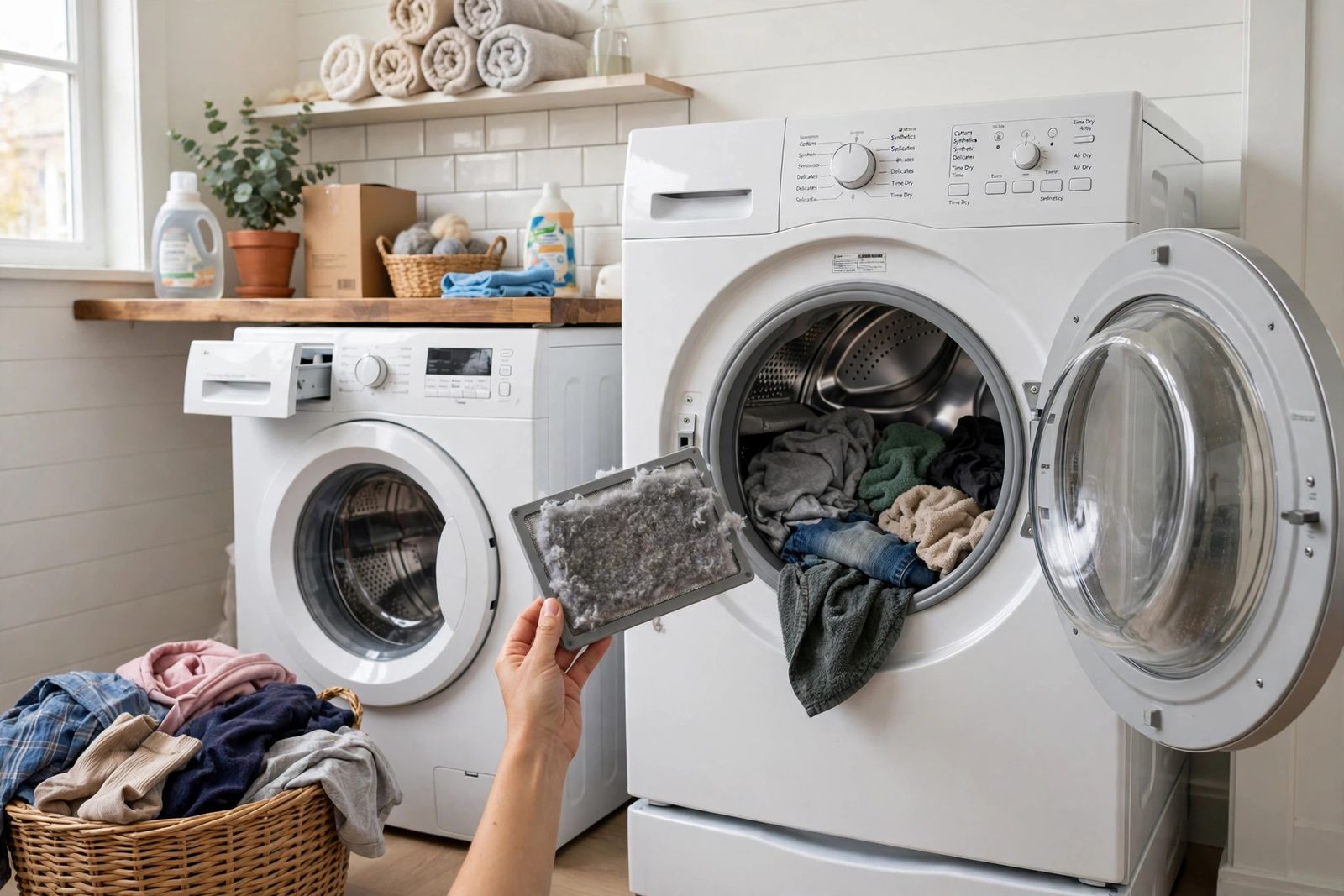
A dryer that runs but does not heat is almost never a dead dryer. The drum and motor are usually fine, and one link in a short chain has stopped the heat: a lint screen or vent so blocked that the dryer overheated and cut its own heat off, a cycle set to air-only by mistake, a half-tripped 240-volt breaker on an electric model, or a safety part — most often the thermal fuse — that has opened for good. Work in that order: the free checks first, the parts inside the cabinet last. GE Appliances makes the power point plainly: an electric dryer may run on a partial 120 volts, but it will not heat without the full 208/240-volt supply.
Two safety rules govern everything below. Unplug the dryer before you open any panel or touch any internal part. And gas work is not a home repair: on a gas dryer you may check the supply valve and watch the igniter, but you do not loosen gas fittings or replace gas valve parts. If you smell gas, leave the house without operating switches and call your gas utility from outside.
First, prove that it really is not heating
Feel is unreliable at the end of a cycle, because most dryers finish with an unheated cool-down. Use the manufacturers’ test instead: Whirlpool’s check is to run the empty dryer five minutes on a heated cycle, then open the door and feel inside. Warm air means it does heat, and your problem is drying performance, not a failed heat part. A stone-cold drum is a true no-heat fault — and some heat with damp clothes points first to airflow and sensing, covered by the same order below.
1. Lint screen and vent blockage — before any part
A dryer moves heat by moving air: in through the drum, out through the lint screen and the duct. Narrow that path and drying slows while heat builds inside the cabinet, until a safety device cuts the heat off. That is why a blocked vent can present as “no heat at all,” not just “takes two cycles.” It is also the fire-safety step: the U.S. Consumer Product Safety Commission’s dryer guidance treats lint build-up in filter, duct and exhaust as the appliance’s central hazard: in long, kinked ducts lint builds up, airflow falls, and trapped lint gets hotter.
- Clean the lint screen properly. Remove the lint by hand every load. Dryer sheets and softener can leave a waxy film that blocks air while the screen looks clean; wash a coated screen with warm water and a soft brush, and dry it fully, as Whirlpool directs. Never run the dryer without the screen.
- Feel the air outside. Running on a heated cycle, the outside vent flap should open to a strong, steady stream of warm air. Weak or pulsing airflow means the path is restricted, kinked, crushed or clogged — Whirlpool’s signs are loads warm but damp, heat and humidity in the laundry room, lint around the door seal.
- Inspect the duct behind the dryer. Unplug, pull the machine out, and check the transition duct for kinks, crushing and lint at both ends. For the duct itself, GE Appliances recommends solid metal vent pipe, 4 inches in diameter, and not white flexible plastic pipe, which can collapse, trap lint and cause the heaters to fail early. Whirlpool agrees, and puts vent cleaning at every one to two years.
- Read the codes. LG’s error-code library defines d75, d80, d90 and d95 as an exhaust duct clogged 75%, 80%, 90% or 95% — and notes that on a gas dryer a d80 can instead mean no gas is reaching the unit, so check the valve before re-cleaning a vent that is already clear. Samsung’s error-code page ties its heating errors (HC, hE) to the same root cause, and its vent test reports C80 (about 80% clogged) and C90 (over 90%). Two nearby code families point a step further: Samsung’s temperature errors (tS, tC and relatives) most often trace back to the same clogged screen or vent, while LG’s tE1 and tE3 name the thermistor — the dryer’s temperature sensor — itself. Treat the vent codes as instructions: clean the screen and the full vent run first. A sensor code that survives that cleaning is a parts diagnosis, not a prompt to clean again.
2. The setting, the load, and the cool-down trap
The cheapest cause of all is a cycle that never calls for heat: Air Dry, Air Fluff and No Heat settings tumble with room air on purpose. Samsung’s troubleshooting page lists “select a heat setting other than Cool air” as its first step, and adds the second trap: make sure the dryer is not simply in its cool-down phase.
Two load problems imitate a heating fault. An overloaded drum restricts tumbling and airflow, and a barely spun load holds more water than the cycle was timed for; Whirlpool suggests keeping the drum roughly half to three-quarters full and re-spinning a dripping load first. On sensor cycles, softener residue coats the moisture-sensor bars, or a tiny load barely touches them, so the dryer decides the load is dry and drops the heat early. If it dries normally on a timed cycle but quits early on sensor cycles, clean the sensor bars and suspect sensing, not the heater.
3. Power supply: half-tripped breaker (electric), closed valve (gas)
Electric dryers run on a double circuit for a reason. The motor can turn the drum on one 120-volt leg; the element needs both legs — the full 208/240 volts. All four makers describe the same failure: one fuse blows or one side of the double breaker trips, and the dryer tumbles with no heat. The fix is one deliberate reset: switch the double breaker fully off, then back on, once. If it trips again, stop: a repeatedly tripping breaker reports a fault in the element, wiring or circuit, and that is electrician territory. Trips on other circuits too are a wider house problem; see why lights flicker.
Gas dryers plug into an ordinary 120-volt outlet for motor and controls, so the equivalent supply check is the gas valve. GE’s gas dryer guide asks for the right heated cycle, an unblocked front, and the gas line turned on. The shutoff handle tells you its state: parallel to the pipe is open, across it is closed. Check the valve behind the dryer and whether other gas appliances work — if they are dead too, the problem is the gas service. Everything past the valve belongs to a licensed technician.
4. Thermal fuse — the small part that stops the most dryers
With airflow clear, the setting heated and the supply whole, the next suspect is the thermal fuse: a one-time safety device on the blower housing or exhaust duct, wired into the heat circuit. When the dryer overheats — most often because of the restricted vent in step 1 — it opens permanently and cuts power to the heater. It cannot be reset, and must never be bypassed.
Testing it means the dryer unplugged, a panel off, and a multimeter on continuity: a good fuse shows continuity; an open reading means it has blown and is replaced with the exact part for the model. The order matters more than the test: fix why it blew before fitting the new one — over a still-blocked vent, the new fuse blows the same way, sometimes within a few loads. A second blown fuse after a thorough vent cleaning points at the thermostats.
5. Heating element (electric dryers)
The element — a coil of resistance wire in a metal housing — is what actually makes the heat. Coils age and break; a coil can also sag onto its housing and ground out, tripping the breaker.
Unplugged, with the element accessed as your manual directs, disconnect one lead and test continuity across its terminals against the value on your model’s technical sheet, since correct readings vary by model. No continuity means a broken coil, and the element is replaced as a unit; continuity from a terminal to the housing means it is grounded and must also be replaced.
6. Igniter and the gas burner sequence (gas dryers)
A gas dryer makes heat in a visible sequence, and watching it — through the observation port if your model has one — shows which link failed:
- The igniter never glows. The igniter may have cracked or burned open, or power may never reach the burner because the thermal fuse has opened. Both are technician tests.
- The igniter glows, then goes out, and no flame lights. The classic signature of weak gas valve coils, which open the valve when the igniter is hot and often work cold and fail warm — also why a gas dryer may heat for the first minutes, then run cold. Coils are replaced as a set, by a technician.
- The igniter glows for a long time and nothing happens. That points to the flame sensor, which tells the valve the igniter is hot enough to open the gas.
Take the symptom, not a shopping list: note which pattern your dryer shows, and how long it heats before quitting. That description is useful to the technician you call.
7. Cycling thermostat and high-limit thermostat
Two thermostats divide the temperature work. The cycling thermostat switches the heat on and off to hold the selected temperature. The high-limit thermostat, on the heater housing, is the guard: it cuts the heat if temperature climbs past a safe ceiling, and is meant to operate rarely.
Their failures mirror each other. A cycling thermostat that fails open leaves no heat, or heat that gives up early, with element and fuse testing good. A high-limit thermostat stuck open kills the heat entirely. And a cycling thermostat that lets the dryer run too hot overheats it until the high-limit or the thermal fuse sacrifices itself — which is why the thermal cutoff and high-limit thermostat are often replaced together as a kit, and why repeated blown fuses after a vent cleaning usually mean a thermostat problem underneath. All are continuity tests done unplugged, against your model’s printed values; ratings are not interchangeable between similar-looking models.
8. Control board and timer — last, because they fail least
At the end of the chain sits whatever tells the heat to turn on: an electronic control board and heater relay on newer dryers, a mechanical timer on older ones. A failed relay can leave every heat part perfect with no power ever sent to them. But the board is the least common cause and the most expensive part on the list, so it is diagnosed last, by elimination: everything above tests good, and still no call for heat. Replacing a board on suspicion is how a small fuse problem turns into a large non-repair. (Heat-pump and ventless dryers have no element or burner: clean the filters and heat exchanger as the manual directs, and leave compressor faults to a specialist.)
When to call a professional, and when to replace instead
Call a technician — and stop opening panels — if you smell gas; if a gas part is the suspected fault; if the breaker trips again after one full reset; if you find scorched wiring or a melted plug; if a thermal fuse blows a second time after a complete vent cleaning; or if the fault survives the fuse, element/igniter and thermostat tests.
The replace decision is separate. A vent cleaning, thermal fuse, thermostat kit, igniter or element on an otherwise sound dryer is normally worth doing. Replacement makes more sense when the dryer is well into its second decade, the repair is a control board or motor rather than a heat-chain part, the same fault was already repaired once, or other age faults wait behind it. As a working rule, a single repair costing more than about half the price of a comparable new dryer, on an already old machine, is money better put toward replacement. Either way, fix the vent first: a new dryer on the old blocked duct inherits the overheating that killed the old one’s fuse — the same logic as a dishwasher not draining or a toilet that keeps running.
Frequently asked questions
Why does my dryer run but not heat at all? On an electric dryer, one tripped leg of the 240-volt breaker leaves the motor turning with no power to the element. On either type, an opened thermal fuse or failed thermostat cuts the heat while the drum keeps tumbling.
Can a clogged vent really cause no heat, or just slow drying? Both. Slow drying is the early stage; as the restriction worsens, heat builds until the high-limit thermostat cycles the heat off or the thermal fuse opens permanently. Then there is no heat until the fuse is replaced and the vent cleared.
My dryer heats at first, then the clothes finish cold. What is that? On a gas dryer, heat that dies a few minutes into every cycle is the classic sign of weakening gas valve coils, which work cold and fail warm. On either type, heat that cuts in and out with a hot cabinet points back to airflow — the high-limit thermostat doing its job against a restricted vent.
Is the thermal fuse resettable? No. It is a one-time device: once open, it is replaced, and never bypassed, because bypassing it removes the overheat protection. A blown fuse is also evidence: something, usually the vent, overheated the dryer — fix that cause or the replacement blows too.
This article is general information, based on the manufacturer support pages and safety guidance linked above. Models differ in part locations, test values and access; your dryer’s manual governs your machine. Gas repairs, and any fault involving scorch marks, melted wiring or a repeatedly tripping breaker, belong to a qualified technician.