

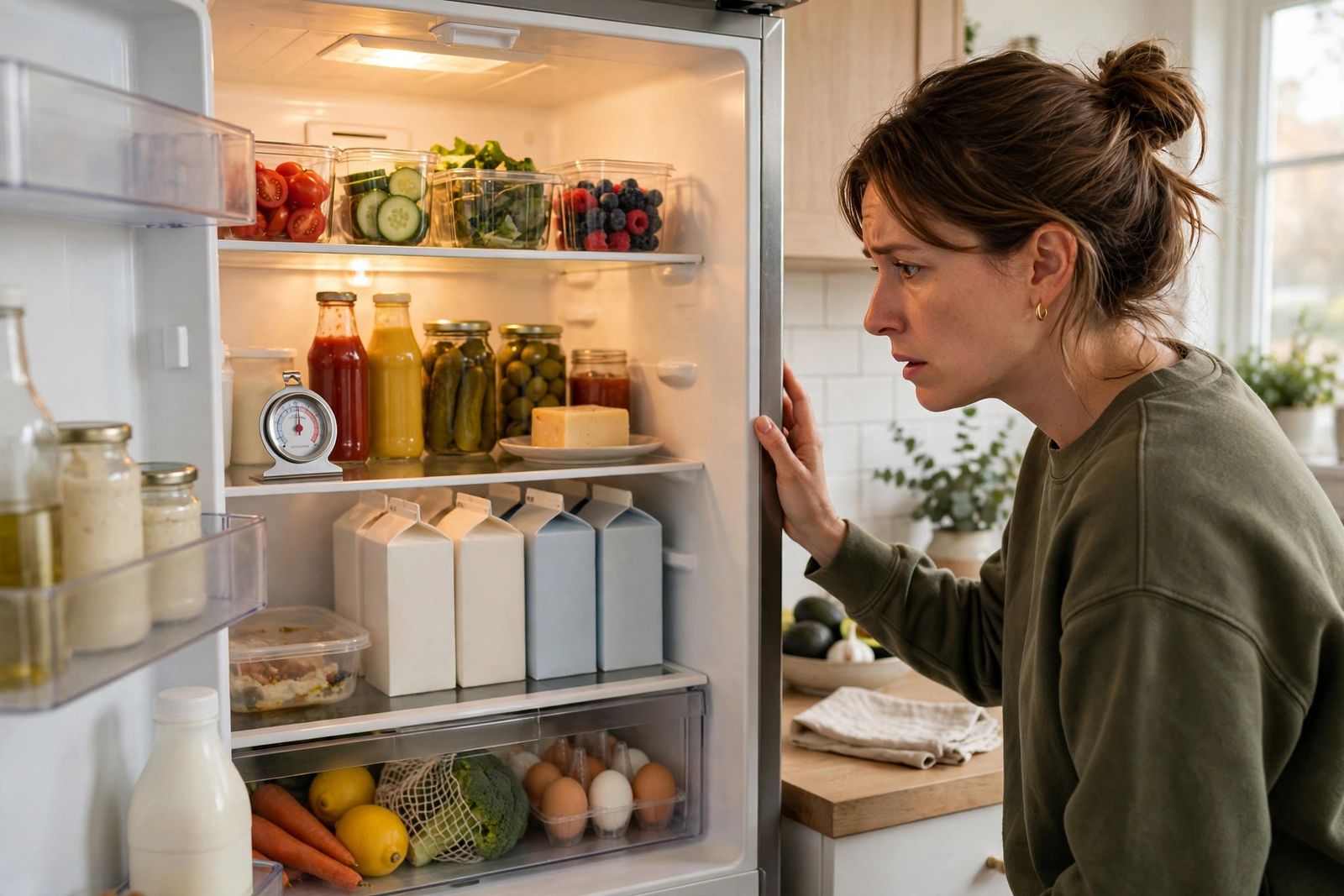
If your refrigerator is not cooling, start with the pattern: if the freezer is still cold but the fresh-food section is warm, the cold is being made but not moved — suspect blocked vents, a stuck damper or a failed evaporator fan first. If both sections are warm, the cold is not being made or not being released — suspect the settings, dirty coils or a door that is not sealing first. Do those free checks before you touch a part, keep the doors closed while you work, and check the food temperature early: perishable food that has spent more than two hours above 40°F (4°C) should be thrown away, not saved by fixing the fridge faster.
Food safety first. The U.S. Food and Drug Administration (FDA) says a refrigerator must stay at 40°F or below and a freezer at 0°F, and that if you are unsure how long food has been at or above 40°F, you should throw it out. Put an appliance thermometer in the middle of the fridge — the dial or display alone does not prove the temperature — and decide about the food first.
Step 1: Confirm the settings, the power and the clock
Many “not cooling” calls end here, and GE Appliances lists the temperature control first in its own not-cooling guidance for the same reason: controls get bumped during cleaning or loading, and an installed, restocked or moved fridge needs time, not parts.
- Check both controls. Aim for about 37°F (3°C) in the fresh-food section and 0°F (-18°C) in the freezer. That sits below the FDA’s 40°F ceiling with a margin for door openings. If a control was set warm, set it one step colder, close the doors and wait. GE’s advice is to adjust by one number or one degree at a time rather than swinging to the coldest setting, which can freeze food without fixing an airflow fault.
- Give it time. A newly installed refrigerator needs about 24 hours to cool down and stabilise. A fridge loaded with a warm shop, or one whose doors were open for a clean-out, needs hours, not minutes.
- Confirm it is actually running. Listen for the compressor and fans, and check the interior light. If there is no light and no sound, check the plug, the socket and the breaker. If the unit is in a defrost cycle, the compressor pauses — that pause is normal and ends on its own.
- Check for a display mode that switches cooling off. On Samsung refrigerators, Cooling Off mode (also called demo or shop mode) leaves the lights and display working while cooling, ice making and the water dispenser are disabled — Samsung’s support page says the display shows OF OF, O FF or scrolling bars in this mode. A recently delivered fridge that has never cooled is in this mode until proven otherwise; follow Samsung’s page or your manual for the exit buttons, which vary by model.
- Check the room and the clearances. GE notes a refrigerator may not cool properly if the room is below 60°F (16°C) or above 110°F (43°C), and that it needs at least an inch of air clearance on each side, the top and the back. A fridge pushed against a wall in a hot garage is working against its surroundings.
Step 2: Fridge warm, freezer cold — clear the vents and check the damper
Most modern refrigerators cool only one place: the evaporator coil in or behind the freezer. Cold air is then pushed into the fresh-food section through vents, controlled on many models by a damper — a small flap that opens and closes to meter the freezer air through. Anything that blocks that path warms the fridge while the freezer stays cold, and GE’s factory-service troubleshooting makes the same split, naming blocked vents, the damper control assembly and the evaporator fan as the suspects when the freezer works and the fridge does not.
- Clear the vents. Find the vents on the shared wall between the freezer and the fridge and inside the fridge section, and move any containers, boxes or bags pressed against them. An overpacked fridge has the same effect: air cannot circulate, cold pools in one corner and the rest warms.
- Look for frost blocking the path. Heavy frost or ice around the vents or on the freezer’s back panel chokes airflow. A manual defrost — unplug, doors open, towels down, 24 hours if the build-up is thick — will restore cooling if frost is the blockage. Do not chip ice with a knife or screwdriver: puncturing a refrigerant line turns a defrost problem into a sealed-system repair. If heavy frost returns within days, the automatic defrost system has failed — a technician’s diagnosis.
- Check the damper. On models with a damper, it sits in a housing at the top or back of the fresh-food section, where the cold air enters. With the fridge running, you should feel cold air coming through when the damper is open. A flap stuck closed — by ice, by a broken linkage or by a failed motor — starves the fridge while the freezer over-cools. Freeing light ice is a homeowner job; replacing a motorised damper is model-specific, so note the model number first.
Clearing vents costs nothing and fixes the most common version of this fault. If the vents are clear and the damper open but no cold air arrives, the fan that moves the air is next.
Step 3: Listen for the evaporator fan
The evaporator fan sits in the freezer, behind a panel, and circulates air over the coil and into both sections. When it fails, the freezer can still feel cold near the coil while the fridge warms.
- The door-switch test. Open the freezer door and press the door switch in, as if the door were closed — on most models the fan only runs with the door treated as shut. With the refrigerator running, you should hear the fan and feel air moving. Silence, grinding or a fan that starts and stops unevenly points at the motor, an obstruction, or ice fouling the blades.
- Look before you conclude. Unplug the refrigerator before you put hands near the fan. Spin the blade by hand: it should turn freely. Ice, a stray label or a cracked blade can stop a good motor. Clear the obstruction, restore power and retest.
- What replacement involves. An evaporator fan replacement means removing the freezer’s rear panel, handling wiring connectors and refitting the blade in the right orientation. It is within reach of a confident owner using the model’s service information, but if you are not comfortable working inside the cabinet, stop here and book service — you will be able to tell the technician the vents are clear, the damper opens and the fan does not run, which shortens the visit.
Step 4: Clean the condenser coils
Condenser coils — underneath the refrigerator behind the front grille, or at the back — release the heat removed from inside. Coated in dust, pet hair and kitchen grease, they release it badly: the compressor runs longer and hotter, and cooling falls away over weeks. GE lists a dirty condenser among its not-cooling checks, and coil cleaning is the most valuable maintenance job.
- Unplug the refrigerator. This is not optional: you will be working near a fan and electrical parts.
- Expose the coils. Remove the front base grille for under-unit coils, or pull the refrigerator forward for rear coils. A full refrigerator is heavy — get help rather than dragging it alone and kinking a water line.
- Brush, then vacuum. Loosen the dust with a long coil brush, then vacuum it with a brush attachment. Work gently, without bending fins or tubing, and vacuum the floor area and grille too.
- Restore and wait. Refit the grille or panel, plug back in, push the unit back leaving its air clearance, and allow several hours, up to a full day after a badly fouled clean, for temperatures to settle.
If the coils were heavily coated and cooling returns, clean them roughly yearly, more often in a house with shedding pets. The same routine helps other appliances — see how to clean a washing machine for the same principle applied to laundry, and dryer not heating for what blocked airflow does to a dryer.
Step 5: Test the door seals
A door gasket that is torn, warped, dirty or no longer magnetically gripping lets warm kitchen air in continuously, and the fridge runs almost constantly while cooling still loses.
- Clean first. Wipe the gasket folds and the cabinet face it meets with warm water and mild detergent. Sticky residue and crumbs are a common free cause of a poor seal.
- The paper test. Close the door on a banknote or a sheet of paper at several points around the frame. You should feel drag as you pull it out. Where it slides out with no resistance, the seal is weak there. Check the corners and the hinge side.
- Look for damage. Cracks, splits, a gasket pulled out of its channel or a door that sits crooked needs more than cleaning. A gasket pushed back into its channel or warmed to reshape a small warp sometimes recovers; a torn gasket needs replacement with the exact part for the model. A door that cannot close because food or a shelf is protruding needs none of this — reseat the contents first.
Step 6: Check the condenser fan
Many refrigerators have a second fan underneath or at the back, beside the compressor: the condenser fan, which pulls air across the coils so they can shed heat. GE’s factory-service guide names the condenser fan motor alongside the evaporator fan when a fridge runs warm or buzzes. With the fridge unplugged, look at the fan near the coils you cleaned in Step 4: the blade should spin freely by hand, with nothing caught in it. A jammed blade, or a motor that never runs while the compressor runs, leaves clean coils unable to shed heat — a fair point to hand over to a technician.
What the thermometer tells you while you work
Keep the thermometer in place through every step. The FDA recommends a freestanding thermometer precisely because few refrigerator controls show actual temperatures, and without it you cannot tell a slow recovery from no recovery. Record the fridge and freezer readings at the start and again a few hours after each fix. A fridge falling steadily, even slowly, is responding; a fridge stuck above 40°F after the vents, coils and seals are done is telling you the fault is in a component, not in the housekeeping.
Perishables — meat, dairy, eggs, cooked leftovers — that have been above 40°F for more than two hours, or for an unknown length of time, should be discarded. Frozen food that holds ice crystals or is at 40°F or below can be refrozen or cooked; food that has thawed and warmed cannot be made safe by refreezing. When in doubt, the FDA’s instruction is to throw it out.
When to call a technician
Stop and book service — GE’s support hub is the route for its own models, and other makers run equivalents — if you meet any of these:
- Both sections stay warm after settings, vents, coils and seals have been checked, which points at the compressor, the start relay, the control board or the sealed refrigerant system. Refrigerant work requires certified handling and is never a homeowner job. A failed temperature sensor (thermistor) belongs here too: it can tell the board the fridge is cold when it is not, and testing it is electrical work.
- The compressor never starts, clicks repeatedly without starting, is unusually hot, or there is a burning smell or repeated breaker tripping. Unplug the unit in those cases.
- Heavy frost returns quickly after a full manual defrost (defrost-system failure, as in Step 2).
- The evaporator fan does not run and you are not comfortable replacing it, or the damper is motorised and failed.
- Oily traces on tubing or a hissing sound, either suggesting a refrigerant leak.
Leave the refrigerator plugged in while you wait for the technician unless it is a safety case above — GE specifically asks owners to do this, so the symptoms are present when the technician arrives. It is the approach used for no hot water in the house as well — identify the type, check the supply, then decide.
Frequently asked questions
Why is my fridge warm but my freezer cold? Because the cold is made in the freezer side and shared. Blocked vents, a damper stuck closed, frost choking the airway or a failed evaporator fan all leave the freezer cold while the fridge warms. Work through steps 2 and 3.
How long should I wait after changing the setting or cleaning the coils? Hours, not minutes — up to 24 hours for a new, moved or heavily loaded refrigerator to stabilise, and several hours after a coil clean.
What temperature should my refrigerator be? At or below 40°F (4°C) for food safety, with about 37°F (3°C) as the practical target and 0°F (-18°C) in the freezer. Verify with a thermometer, not the dial.
Can I keep food if the fridge was warm overnight? Only if you can show it stayed at or below 40°F, or was above it for two hours or less — the thermometer section’s rule. If you do not know how long it was warm, discard perishables. Do not taste food to test it.
This article is general information based on the manufacturers’ and FDA guidance linked above and checked in November 2026. Refrigerator layouts, damper and fan locations and control types vary by model — follow your manual for part locations, unplug the appliance before cleaning coils or touching the fan, and leave refrigerant, compressor and electrical-board work to a qualified technician.